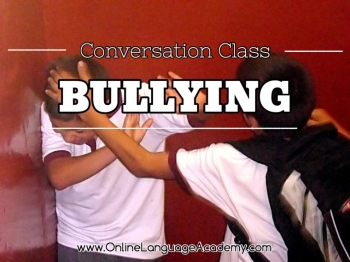
Conversation class on Bullying
In this week's English conversation classes we will be talking about Bullying, and looking at the Passive in English.
Book a class
Not an OLA student yet? Sign up for your FREE trial class now!
Online English classes with our fun and friendly native English speaking teachers are the best way to improve your spoken English! And remember: practice makes perfect!
Physical threats are typical of bullies.
Book a class
In this first class we will be looking at a quote based on Bullying, and discussing some questions based on vocabulary related to the topic. We also recommend that you take some time to study the common pronunciation problems and common mistakes that our students make.
Quote:
Discuss the following quote with your native English teacher via Skype:
"If they don’t like you for being yourself, be yourself even more."
– Taylor Swift

Questions to discuss with your teacher:
1. What different types of bullying are there?
2. What can people who are bullied do to stop the bullying?
Check your pronunciation of the vocabulary with your native English teacher, and discuss the questions below:
| Vocabulary | Questions |
| A bully | Describe a bully from your school days. |
| Bullying | How big a problem was bullying when you went to school? |
| To be bullied | Is it worse for children or adults to be bullied? |
| To prevent | What can parents do to prevent their child from being bullied? |
| To stand up for someone | If someone you knew was being bullied, would you stand up for them or would you be a bystander? |
| To gossip | Do you think that gossiping is one of the worst forms of bullying? |
Common pronunciation problems
Target 
Humiliate
Cyberbully
Common Mistakes
| ✘ I was scary | ✔ I was scared / I was afraid |
| ✘ I was bully when I was a child | ✔ I was bullied when I was a child |
| ✘ She is very gossip | ✔ She likes to gossip a lot |
Trolling and cyberbullying have become a serious problem.
Book a class
In this class we will be looking at more questions and vocabulary related to Bullying, specifically a new kind of bullying that has arisen since the birth of social media.
We also recommend you to watch the video before your English class, so you can discuss it with your English teacher.
Questions to discuss with your teacher:
1. Do you think that students who are bullied need more help from teachers than their bullies do?
2. What kind of help do bullies need?
Check your pronunciation of the vocabulary with your native English teacher, and discuss the questions below:
| Vocabulary | Questions |
| Cyberbully | What is a cyberbully? |
| Trolling | What type of bullying is worse, trolling (online bullying) or bullying that is face-to-face? |
| To target | What type of people are usually targeted by online bullies? |
| To commit suicide | If a victim commits suicide, should the bully be charged with murder? |
| Campaigns | Why do some people think anti-bullying campaigns are ineffective? |
Now discuss the video with your English teacher in your online conversation classes via Skype:

Click to do the English listening exercise on this video!
Book a class
 Reading Practice:
Read and discuss the article on Knowing Why Bullies Bully with your native-speaking English teacher online via Skype:
“Almost everyone has been bullied at one time or another, and we often take solace in the assumption that living well is the best revenge. We will have happy and fulfilling lives whereas bullies are trying to compensate for their own low self-esteem and will lead miserable lives. Read more…
Questions to discuss with your English teacher
1. How damaging is bullying according to the CDC?
2. What advantages or benefits are there to bullying?
3. How is 'social competition' similar to bullying?
4. How does the article say that bullying can be stopped?
| Present | Past | Participle |
| Beat | Beat | Beaten |
| Forget | Forgot | Forgotten |
| Feel | Felt | Felt |
English grammar review

Revision of the Passive Voice in English
The passive is used when the the person doing the action is unknown or not important, and so this tense is commonly used when talking about bullying.
This is how we form the passive: Object + Be + Past Participle
And here are some examples, along with some great vocabulary related to bullying...
Examples in the past tense:
Examples in the present tense:
Examples in the future tense:

Improve your English writing skills by choosing one of the following essay questions, and sending it to us for correction.
We will reply within 48 hours with the corrected text, clearly marking your mistakes, and a feedback sheet, which you can use to improve your future written work.
Buy a Writing Correction pack now

See our other English conversation lessons, to improve your grammar and vocabulary, and practice your reading and listening skills.
And don't forget to book your online English conversation classes with one of our native English-speaking teachers to put into practice what you’ve learned in this lesson.
Book a class
Not an OLA student yet? Sign up for your FREE trial class now!
GET FREE LESSONS

Owner of OLA Online Language Academy
★Degree in French (University of Kent at Canterbury)
★DELE Superior (Spanish) (Instituto Cervantes, Leeds)
★TEFL (Teaching English as a Foreign Language) (i-to-i.com)
 10 English Expressions and Idioms about Anger
 Corporate Responsibility. Speaking exercise
 Conversation Class: Ways To Be Productive
 Dream Jobs. Speaking exercise
Call now for more information!
ola.academy
Follow us