Conversation class on Bad Habits
In this week's English lesson we will be talking about bad habits, and looking at the present continuous with always to express annoyance.
Book a class
Not an OLA student yet? Sign up for your FREE trial class now!
Online English classes with our fun and friendly native English speaking teachers are the best way to improve your spoken English! And remember: practice makes perfect!
Quote about bad habits
Book a class
In this first class we will be looking at a quote by Benjamin Franklin on bad habits, and discussing some questions based on vocabulary related to annoying habits. We also recommend that you take some time to study the common pronunciation problems and common mistakes that our students make.
Quote:
Discuss the following quote with your native English teacher via Skype:
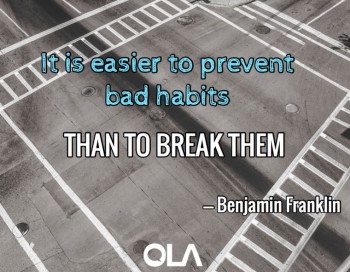
"It is easier to prevent bad habits than to break them"
– Benjamin Franklin

Questions to discuss with your teacher:
1. Did you have any bad habits as a child that you don’t have now?
2. Do you have any new habits as an adult?
Check your pronunciation of the vocabulary with your native English teacher, and discuss the questions below.
| Vocabulary | Question |
| Habit | What is the worse habit that you have? |
| Annoy | Who do you annoy with your bad habits? How do they react? |
| Annoying | What is the most annoying habit in your opinion? |
| Pick up | Why do we pick up bad habits? |
| Therapy | Is reading therapy books a good way to stop bad habits? |
Common pronunciation problems
Bite 
Workaholic
Liar
Common mistakes
| ✘ I bite my fingers | ✔ I bite my fingernails |
| ✘ People who speak loudly are very annoyed | ✔ People who speak loudly are very annoying |
| ✘ It's not easy breaking bad habits | ✔ It's not easy to break bad habits |
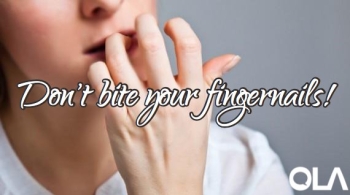
Do you bite your fingernails?
Book a class
In this class we will be looking at questions and vocabulary related to bad habits in the workplace.
We also recommend you watch the video before your English class to be able to discuss it with your English teacher.
Questions to discuss with your teacher:
1. Who is the most annoying person in your place of work/class?
2. What makes them annoying?
Check your pronunciation of the vocabulary with your native English teacher, and discuss the questions below.
| Vocabulary | Question |
| Workaholic | Is it OK to be a workaholic? |
| Lying | Can lying be considered a bad habit? Do you know any liars? |
| Fingernail biting | What ways can you think of to stop fingernail biting? |
| Snacking | Some people say snacking is a bad habit. How can this be stopped? |
| Lead to | What problems can some of the bad habits we’ve talked about lead to? |
Now discuss the video with your English teacher in your online conversation classes via Skype:

Click to do the English listening exercise on this video!
Book a class
 Reading Practice:
This article talks about 10 bad habits, why they're dangerous, why you should stop and how you can reverse the habit. Read and discuss the article with your native-speaking English teacher online via Skype:
"It's not too late to reverse your worst habits (stopping smoking, drinking, over-eating, and more) and immediately start living a happier, healthier life." Read more…
.
Irregular Verbs
| Present | Past | Participle |
| Bite | Bit | Bitten |
| Lie | Lied | Lied |
| Lead to | Led to | Led to |
English grammar review

Present continuous + 'always' to express annoyance
You might know that we use the present simple with adverbs of frequency such as never, hardly ever, sometimes, often, always, usually, normally. However, did you know the following...?
We use the present continuous with always to describe things that we find annoying or irritating.
We can also use forever and constantly instead of always.
Here are some examples of using the present continuous to express annoyance.

Improve your English writing skills by choosing one of the following essay questions, and sending it to us for correction.
We will reply within 48 hours with the corrected text, clearly marking your mistakes, and a feedback sheet, which you can use to improve your future written work.

See our other English conversation lessons, to improve your grammar and vocabulary, and practice your reading and listening skills.
And don't forget to book your online English conversation classes with one of our native English-speaking teachers to put into practice what you’ve learned in this lesson.
Book a class
Not an OLA student yet? Sign up for your FREE trial class now!
GET FREE LESSONS

Owner of OLA Online Language Academy
★Degree in French (University of Kent at Canterbury)
★DELE Superior (Spanish) (Instituto Cervantes, Leeds)
★TEFL (Teaching English as a Foreign Language) (i-to-i.com)
 Fair Trade. Speaking exercise
 Christmas. Speaking exercise
 Video Game Violence. Speaking exercise
 Animal Testing. Speaking exercise
Call now for more information!
ola.academy
Follow us