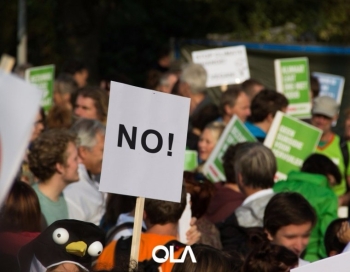
Conversation class on Protests
In this week's lesson you will learn the necessary skills to talk about protests in English with your online English teacher via Skype.
Book a class
Not an OLA student yet? Sign up for your FREE trial class now!
Online English classes with our fun and friendly native English speaking teachers are the best way to improve your spoken English! And remember: practice makes perfect!
Quote on protests

Book a class
In this first class we will be looking at a quote by Edward Abbey, and discussing some questions based on vocabulary related to demontrations and strikes.
We also recommend that you take some time to study the common pronunciation problems and common mistakes that our students make.
Before we get started, let's look at a couple of warm-up questions on the topic of 'fight for what is right'.
Warm-up questions to discuss with your teacher
1. Is it common for people to protest in your country?
2. Where and what do they usually protest about?
Now check your pronunciation of the below vocabulary with your native English teacher, and discuss the questions to put this new vocabulary into use.
Vocabulary
Question
Protester
Are you a protester? Do you know someone that is?
Signs / Posters
Why do protesters use signs and posters?
Chant
What kind of things do people usually chant when protesting?
Strike
Do you know anyone that has gone on strike? Why did they do it?
Petition
Have you ever signed a petition? What was it for?
Quote of the Day
Finally, discuss the Quote of the Day with your native English teacher via Skype.
First explain the meaning, and then say whether you agree or disagree:
"A patriot must always be ready to defend his country against his government."
– Edward Abbey
Common pronunciation problems
Fought 
Fought 
Neutral
Neutral
Signs
Signs
Common mistakes
| WRONG | RIGHT |
| ✘ There are many manifestations in my country. | ✔ There are many demonstrations in my country. |
| ✘ People often do a strike. | ✔ People often go on strike. |
| ✘ The politics don't listen. | ✔ The politicians don't listen. |
Get up, Stand up!
Book a class
In this class we will be looking at questions and vocabulary related to solving the problem.
We also recommend you watch the video before your English class to be able to discuss it with your English teacher.
Before we get started, let's look at a couple of warm-up questions on the topic of protests.
Warm-up questions to discuss with your teacher
1. Why do people protest?
2. Do you agree with protesting? Why/why not?
Now check your pronunciation of the below vocabulary with your native English teacher, and discuss the questions to put this new vocabulary into use.
| Vocabulary | Question |
| Accomplish | What have protests accomplished in your country? |
| Politics | Why do people generally protest about politics? |
| Neutral | Do you think it is better to be neutral or participate in politcs? |
| United | How can we be united? |
| Peaceful | Will it ever be possible to live in a peaceful world? Explain. |
Now discuss the video with your English teacher in your online conversation classes via Skype:

Click to do the English listening exercise on this video!

Book a class
This article talks about the top 10 most influential protests of all-time. Read and discuss the article with your native English-speaking teacher online via Skype:
Article “The Boston Tea Party is something of a misnomer, as while it did indeed feature tea, it was definitely not a party. On a cold December evening, protesters gathered in Boston Harbor to reject the latest shipment of tea from the East India Co. They were speaking out against the Tea Act, which allowed the East India Co. to sell its tea at reduced cost, thus giving the British-government-controlled company an effective monopoly." Read more… Questions to discuss with your English teacher 1. Why is the Boston Tea Party something of a misnomer? 2. Where did the protesters gather in Boston? 3. Why were the protesters in Boston protesting? 4. As the story goes, what did the colonists do? 5. Under colonial law, what were the Indians forbidden to extract?
Irregular Verbs
| Present | Past | Participle |
| Fight | Fought | Fought |
| Forbid | Forbade | Forbidden |
| Hold | Held | Held |
Role play on Protests
Book a class
Role plays are a fantastic way of practicing real life English expressions, which are incredibly important to know if you want to increase your fluency and speak English like a native speaker.
Choose your favourite role (role A or role B) and practice the below role play with your native English teacher via Skype. Your teacher will help you with typical spoken English expressions that will help you speak English like a native speaker!

Improve your English writing skills by choosing one of the following essay questions, and sending it to us for correction.
Have you ever participated in a protest? If so, discuss the event and why you got involved. If not, are there any issues that you feel strongly about and would join a protest for?
Large-scale protests can take the shape of a crowd of people gathered in one place, perhaps in front of a government building, shouting slogans and toting signs. But there are other ways to protest or show your disagreement with something. Discuss some of those other methods.
We will reply within 48 hours with the corrected text, clearly marking your mistakes, and a feedback sheet, which you can use to improve your future written work.
See our other English conversation lessons, to improve your grammar and vocabulary, and practice your reading and listening skills.
And don't forget to book your online English conversation classes with one of our native English-speaking teachers to put into practice what you’ve learned in this lesson.
Book a class
Not an OLA student yet? Sign Up for your FREE trial class now!
GET FREE LESSONS

Owner of OLA Online Language Academy
★Degree in French (University of Kent at Canterbury)
★DELE Superior (Spanish) (Instituto Cervantes, Leeds)
★TEFL (Teaching English as a Foreign Language) (i-to-i.com)
 10 English Expressions and Idioms about Anger
 Tipping. Speaking exercise
 Extreme Sports. Speaking exercise
 Punctuality. Speaking exercise
Call now for more information!
ola.academy
Follow us