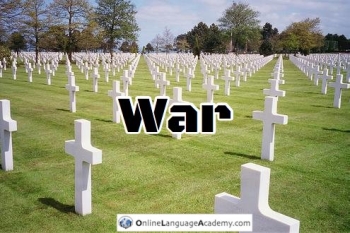
War cemetery in France
In this lesson we will be talking about Military Service and War in English, and looking at modals of necessity (must, have to, have got to)..
"I am not afraid of an army of lions led by a sheep; I am afraid of an army of sheep led by a lion."
— Alexander the Great
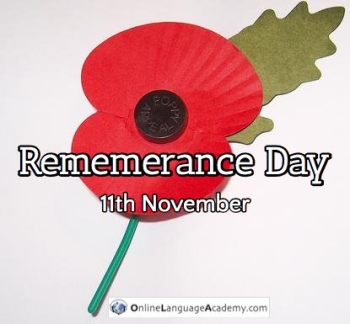
Each year around the beginning of November, you will see English people in the streets, on TV, at football matches etc. wearing a red poppy on their jacket, in remembrance of those who died during the two World Wars and consequent wars. Remembrance Day (or “Veterans Day” in the USA) takes place on the 11th November, as the armies stopped fighting World War I at 11:00, on 11th November, 1918 (the eleventh hour of the day of the eleventh month).
In England, there is a Remembrance ceremony on the Sunday closest to the 11th November, in which the royal family, politicians and members of the armed forces pay tribute to those who lost their lives fighting for their country.
We’ve come a long way since 1918, though war, sadly, remains a current topic of conversation.
Before we get started, here is a list of vocabulary that will help you talk about military service and war, with your native English-speaking teacher in your conversation classes via Skype.
In England the poppy is used to remember those who died fighting for their country.
English vocabulary related to War
| community service |
| to invade |
| to dread something |
| poppy |
| the army / the armed forces |
| obedient |
| veteran |
| wound |
| shoot |
| casualties |
| Rememberance Day / Armistice Day |
Grammar to use in your online English conversation class
Modals of necessity (must, have to, have got to)
Must, have to and have got to show that something is necessary.
1. MUST
Must is the strongest modal of necessity. However we do not usually use must in questions. And we do not use must in the future or past tenses.
Examples:
The negative of must is must not, and is used for rules and regulations.
Examples:
2. HAVE TO
Have to is the most commonly used modal of necessity. We can use it in questions, and we can conjugate have to use it in all the different tenses.
Examples:
The negative is formed the same as any normal verb.
Examples:
3. HAVE GOT TO
Have got to is used in informal speech, and like 'must', we only use it in the present tense.
Examples:
To form the negative, we use the contraction of have + not: haven’t
Examples:
Useful verb forms:
Common mistakes:
X I must to study more
√ I must study more (without 'to')
X Millions of people are died at war
√ Millions of people are KILLED at war
X Make military service
√ DO military service
X I would have afraid
√ I would BE afraid
Common pronunciation problems:
The Uncle Sam poster was used to recruit people for the U.S army during the two World Wars.
Questions we will discuss in your online English conversation class:
What is military service? Is it compulsory in your country?
Did you or anyone you know do military service?
What are some of the jobs that soldiers do?
Do you think women should be soldiers?
Do many young people in your country join the army? Why/why not?
Do you know anyone who is in the army or who has been? Tell me about him/her.
Why do you think people want to become soldiers?
Has anyone in your family ever fought in a war?
Is war necessary?
If war could be eliminated entirely, would there still be a use for armies?
Do you think it is morally wrong to kill ?
How could people resolve conflicts instead of through war ?
Practice reading and listening before speaking with your native English-speaking teacher:
This article talks about the proposed idea to reintroduce military service in the UK, after it was originally abolished in 1960.
“The bill was brought to parliament by Conservative MP Philip Hollobone, who has championed the legislation as a way to inspire young people in Britain with “self-respect, personal reliance, discipline and behavior….” Read more…
And this short video is an interview with a war veteran from the USA, who fought in Iraq. We rarely think about how soldiers feel after their time at war, and so this is an interesting perspective.
Do listening exercise on this video!
Speaking practice:
Now book your online English conversation class with one of our native English-speaking teachers to put into practice what you’ve learned in this lesson.
Book a class
Only by doing this will you improve the most important communication skill in English: speaking!
Not an OLA student yet? Sign up for your FREE trial class now!
See our other lessons, and improve your grammar and vocabulary with our well-thought out lesson plans to ensure you learn how to speak real English!
Like this lesson? Please share it via social media…

Owner of OLA Online Language Academy
★Degree in French (University of Kent at Canterbury)
★DELE Superior (Spanish) (Instituto Cervantes, Leeds)
★TEFL (Teaching English as a Foreign Language) (i-to-i.com)
 One Simple Tip to Speak Advanced English
 Extreme Sports. Speaking exercise
 Roommates. Speaking exercise
 Sleep and Dreams. Speaking exercise
Call now for more information!
ola.academy
Follow us