Fair Trade coffee beans
In this lesson we will be talking about Fair Trade, and looking at the construction “What if…?” in English.
Book a class
"I pity the man who wants a coat so cheap that the man or woman who produces the cloth will starve in the process."
– Benjamin Harrison
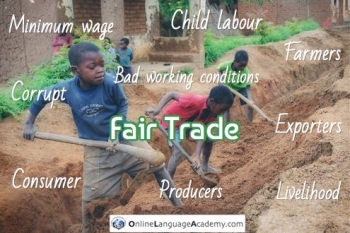
From the man, woman or child who picks the coffee beans, to you paying for it at the supermarket, there are a lot of ‘middle men’ who all need to make a profit. Surprisingly little of your money goes to the farmers who work 10 or more hours a day, breaking their backs to pick your coffee beans, and so the Fair Trade movement was created in order to get more money to those who work tirelessly for an incredibly low salary and poor working conditions.
Before we get started, here is a list of vocabulary that will help you talk about Fair Trade with your native English-speaking teacher in your conversation classes via Skype.
Vocabulary about Fair Trade
English vocabulary related to Fair Trade
| conscience | a sense of what is right and wrong |
| consumer | buyer |
| corrupt | to be dishonest for personal gain |
| enforce | to make sure rules are followed |
| exporters | the people who export the goods |
| farmers | people who work in agriculture |
| invest | spend money with hopes of making a profit |
| livelihood | a means of financially supporting your existence |
| mass produced | made in very large quantities |
| minimum wage | the lowest amount of money you can pay a worker |
| producers | the people who make the goods |
| sustainability | the capability of being maintained at a steady level |
Grammar to use in your online English conversation class
Here are the different ways we can use the “What if…?” construction.
A. “What if + present simple ?”
We use this construction when we are asking about the consequences of an action.
Examples:
We can also use this construction to make suggestions.
Examples:
B. “What if + past simple ?”
We use this construction to talk about future possibility, (with a low probability).
Examples:
Useful verb forms:
Common mistakes:
A café is a place where you go for a drink. A coffee is a drink.
Both café and coffee have the stress on the first syllable!!
False Friend:
X invert = to reverse in position
√ invest = to spend money, hoping to make a profit
Common pronunciation problems:
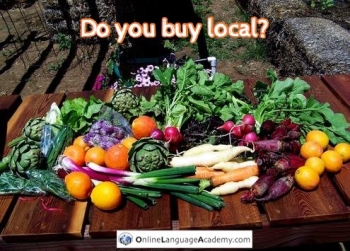
Do you buy local?
Questions we will discuss in your online English conversation class:
- Why are products that are made far away sometimes the least expensive?
-What does the term “fair trade” mean to you?
- Do you prefer to buy your products from local farms and family-run shops, or from large supermarkets? Why?
- Do you check where a product is made before you buy it?
- Do you know of any fair trade products that are sold in your country?
- Have you ever drunk fair trade coffee / eaten fair trade chocolate? If so, are fair trade products as nice as non fair trade products?
- Have you ever bought a fair trade product?
- What fair trade products have you seen advertised on TV?
- Do you think fair trade products are too expensive?
- Why do you think fair trade products are more expensive?
- Have you heard of fair trade universities or fair trade towns? What do you think these are?
- Do you think we should have more fair trade in your country?
- Do you think it is correct to have fair trade in all countries?
- What can people in developed countries do to help reduce poverty around the world?
Practice reading and listening before speaking with your native English-speaking teacher:
Although fair trade seems an inspiring initiative, it is not without its doubters and critics. This article looks into just how “fair” fair trade is.
“The Fairtrade label is increasingly common. But while shoppers seem keen to pay a little over the odds for fair trade products, some observers question how effective it really is in helping developing world farmers…” Read more...
Writing Practice:
Improve your English writing skills by answering the following essay question, and sending it to us for correction.
The money given to help poor countries does not solve the problem of poverty, so rich countries should give other types of help instead. To what extent do you agree or disagree?
We will reply within 48 hours with the corrected text, clearly marking your mistakes, and a feedback sheet, which you can use to improve your future written work.
Buy a pack of Writing Corrections!
Speaking practice:
Now book your online English conversation class with one of our native English-speaking teachers to put into practice what you’ve learned in this lesson.
Book a class
Only by doing this will you improve the most important communication skill in English: speaking!
Not an OLA student yet? Sign up for your FREE trial class now!
GET FREE LESSONS
See our other lessons, and improve your grammar and vocabulary with our well-thought out lesson plans to ensure you learn how to speak real English!

Owner of OLA Online Language Academy
★Degree in French (University of Kent at Canterbury)
★DELE Superior (Spanish) (Instituto Cervantes, Leeds)
★TEFL (Teaching English as a Foreign Language) (i-to-i.com)
 Speaking Exercise: What all intelligent people have in common!
 Speaking Exercise: How to Stay Motivated
 Sleep and Dreams. Speaking exercise
 Responsible Tourism. Speaking exercise
Call now for more information!
ola.academy
Follow us