Conversation class on Superstitions
In this week's English lesson we will be talking about Superstitions, and looking at the grammatical construction it's + adjective + to.
Book a class
Not an OLA student yet? Sign up for your FREE trial class now!
Online English classes with our fun and friendly native English speaking teachers are the best way to improve your spoken English! And remember: practice makes perfect!
Quote on superstitions
Book a class
In this first class we will be looking at a quote by Chuck Palahniuk, and discussing some questions based on vocabulary related to superstitions. We also recommend that you take some time to study the common pronunciation problems and common mistakes that our students make.
Quote:
Discuss the following quote with your native English teacher via Skype:
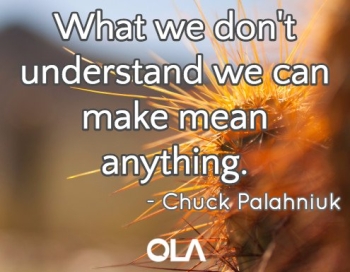
"What we don't understand we can make mean anything."
– Chuck Palahniuk

Questions to discuss with your teacher:
1. Where do superstitions come from?
2. Why do people believe in superstitions? Do you believe in superstitions?
Check your pronunciation of the vocabulary with your native English teacher, and discuss the questions below.
| Vocabulary | Question |
| Superstition | What is superstition? |
| Culture | How does culture affect superstition? |
| Evil Spirits | Why do people belive that evil spirits harm us? |
| Coincidence | What is the difference between superstition and coincidence? |
| Supernatural | What is your opinion about supernatural forces? |
Common pronunciation problems
Supernatural 
Myth
Culture
Common mistakes
| ✘ I have very lucky. | ✔ I am very lucky. |
| ✘ I am very superstition. | ✔ I am very superstitious. |
| ✘ It's bad luck walking under a ladder. | ✔ It's bad luck to walk under a ladder. |
Is the number 13 lucky or unlucky?
Book a class
In this class we will be looking at questions and vocabulary related to the influence of superstitions on our daily lives.
We also recommend you watch the video before your English class to be able to discuss it with your English teacher.
Questions to discuss with your teacher:
1. What are some superstitions that exist in your country/culture?
2. What is a superstition that you believe in?
Check your pronunciation of the vocabulary with your native English teacher, and discuss the questions below.
| Vocabulary | Question |
| Myth | In what way are myths like superstions? |
| Luck | If you believe in superstitions, will you receive good luck? |
| Horoscope | Do you consider horoscopes to be superstitious? Why? |
| Shooting Star | What do people usually do when they see a shooting star? |
| Miracle | Have you ever been a witness of a miracle? Explain. |
Now discuss the video with your English teacher in your online conversation classes via Skype:

Click to do the English listening exercise on this video!
Book a class
 Reading Practice:
This article talks about intersting facts on some of our superstitious beliefs. Read and discuss the article with your native-speaking English teacher online via Skype:
“Are you superstitious? Fun Facts to know about some of our superstitious beliefs." Read more…
Questions to discuss with your English teacher
1. What impression did Diane Duyser think appeared on her toasted cheese sandwich in 1994?
2. What did baseball great Wade Boggs eat before every game?
3. What is thought to being good luck when hung over a door way?
4. At what age do people become less superstitious?
5. What is a common superstition for pilots?
Irregular Verbs
| Present | Past | Participle |
| Burn | Burnt | Burnt |
| See | Saw | Seen |
| Understand | Understood | Understood |
English grammar review

It's + adjective + to
We use the grammatical construction it's + adjective + to to describe a verb, putting emphasis on the adjective. We can also use this construction with it's good luck to and it's bad luck to, which is very useful when talking about superstitions.
Examples:

Improve your English writing skills by choosing one of the following essay questions, and sending it to us for correction.
We will reply within 48 hours with the corrected text, clearly marking your mistakes, and a feedback sheet, which you can use to improve your future written work.

See our other English conversation lessons, to improve your grammar and vocabulary, and practice your reading and listening skills.
And don't forget to book your online English conversation classes with one of our native English-speaking teachers to put into practice what you’ve learned in this lesson.
Book a class
Not an OLA student yet? Sign up for your FREE trial class now!
GET FREE LESSONS

Owner of OLA Online Language Academy
★Degree in French (University of Kent at Canterbury)
★DELE Superior (Spanish) (Instituto Cervantes, Leeds)
★TEFL (Teaching English as a Foreign Language) (i-to-i.com)
 Extreme Sports. Speaking exercise
 Tipping. Speaking exercise
 Smoking. Speaking exercise
 10 English Expressions and Idioms about Anger
Call now for more information!
ola.academy
Follow us